


At the end of the Sukkot season, we return to the story of Genesis.
We tell the story of how the first man and woman were exiled from the Garden. A perfect place where humans and G-d were in constant contact. The Garden of Eden, a paradise full of the beauty of life, in perfect alignment with our deepest selves.
As the story goes, Adam and Eve eat from the forbidden Tree of Knowledge and, as a result, are cast out. Expelled from this idyllic place and into a world where darkness and danger abound.
It is a sad story when told that way. A reminder of what we can lose when we let our guard down.
But I believe there might be another way to understand it. A deep lesson for us to reclaim what we lost that day, at least in some way.
And there might be a deep relationship between that story and the holiday of Sukkot.
Exiled into our own minds
Perhaps leaving the Garden was not a punishment inflicted upon us by G-d in retribution.
What if it was simply the natural consequence of having tasted from the Tree of Knowledge?
There is a narrative we can perhaps see within the story, one that may have something important to teach us about our lives in this modern world.
Adam and Eve lived in a garden, a place where experience was the primary mode of connection with G-d. We were in His presence and soaked it up every moment.
But we were warned that if we ate from the Tree, our reality would change. We would no longer experience the closeness that had been available to us.
The Tree of Knowledge.
And that is exactly what happened.
When we ate from the Tree, we acquired knowledge, but at a terrible price.
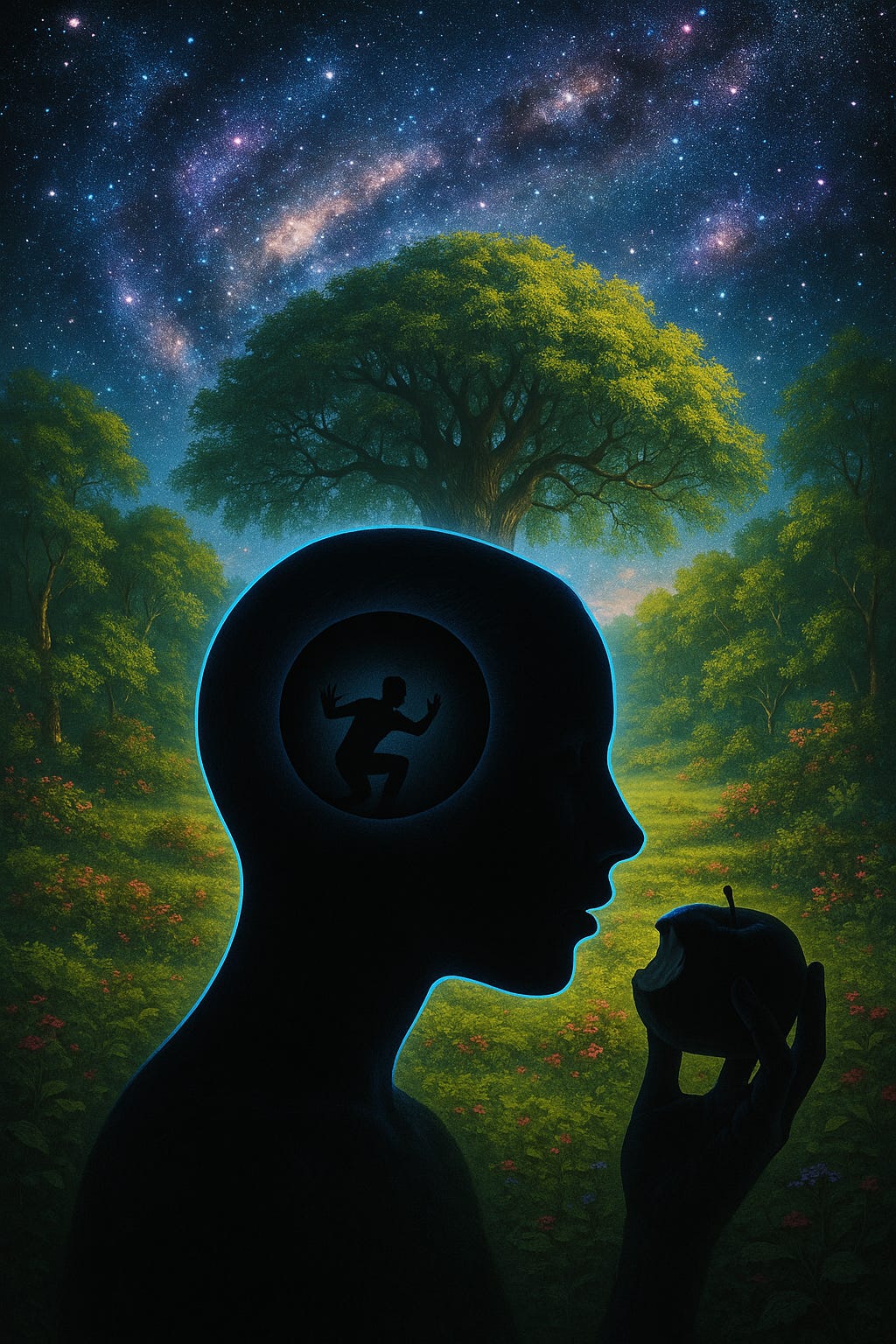
The moment we developed the current version of our intellect, we were effectively exiled from the Garden.
Not out into the world.
Straight into our own minds.
Within that prison, we became unable to experience the Garden that still surrounded us.
We left the present moment, the moment of life where we can truly experience G-d’s light, and entered instead into ideas, conceptions and stories. Cheap replacements for the real moments we allow to pass us by.
It was not a curse as much as it was a consequence of our removal from the perfect Garden of the present moment, where G-d comes in contact with His creation and everything simply is as it should be.
In the Garden there is a state of flow, of pure being, with no narratives attached.
No foreknowledge.
No clarity.
No thinking ahead.
Just a pure state of being. G-dly presence in the shape of existing for this very second.
The three things that occupy our minds
Instead, we became trapped in ideas, concepts and theories.
Narratives and stories that we weave in order to make sense of the reality around us.
Past scenarios.
Future scenarios.
Our minds everywhere and anywhere but here.
The consequences described in Genesis seem to revolve around three areas: children and birth, mortality and health, and livelihood.
Banei, chayei, mezonei.
The three areas that concern us most. The things that inhabit our minds perhaps more than anything else.
Of course, these things themselves are not curses. Children, life and sustenance are among our greatest blessings.
But they contain the roots of so much of what concerns the human mind.
Will my children be okay?
Will I be healthy?
How long will I live?
Will I have enough?
How will I support my family?
What happens tomorrow?
And so these concerns can pull us away from the life directly in front of us and into a spiral of constant rumination, anxiety and stress.
From there emerge anxiety, hate, anger, fear, depression, obsessive thinking and so many of the other things that keep us away from the present moment.
Away from the place where we can connect.
The Garden never disappeared
And so we have toiled ever since to get back to that Garden.
To someday retrieve what we lost and so dearly miss.
But the ironic tragedy may be that we never actually left.
We only lost the ability to see it.
The good news is that, if we were to simply open our eyes, the Garden is available to us at any given moment.
Because life, when truly lived, is the Garden we are searching for.
The present moment.
The divine light contained within every preciously unique second and every breath.
I found a note I once wrote:
Hashem’s name YHVH is the continuous form of the verb to create. But it is also connected to the continuous experience of presence. To connect with Hashem is to be continuously present. Alternatively, the present moment itself is an expression of Hashem.
Perhaps that is why the present is so different from every moment in the past or future.
Because it is alive.
The past exists now only as memory.
The future exists now only as imagination.
But this moment takes place.
And then comes Sukkot
I believe it is no coincidence that we encounter these ideas so close to Sukkot.
Sukkot is a holiday that asks us to leave behind, at least temporarily, some of the complexity of our amassed possessions and return to a simpler, purer and more natural way of living.
We leave our permanent homes.
We sit beneath branches.
We eat outside.
We take plants and fruit into our hands.
We become slightly less insulated from the world around us.
Less distracted.
Closer to our roots.
Closer to the Earth.
Closer to the G-dliness invested within nature.
Elokim, G-d’s name associated with creation and concealment, has the same numerical value as hateva, nature.
Nature itself can become a vehicle for revealing G-dliness.
It is a way we can connect with Hashem in a pure and raw form.
When we truly experience nature, when we become fully present within it, something happens.
Space and time begin to converge.
The physical world around us and the living present moment meet.
And there, perhaps, we experience a revelation of G-d.
Maybe this is also connected to why Sukkot is called Zman Simchateinu, the time of our rejoicing.
Because perhaps true joy is not found by finally controlling life.
It is found by finally being there for it.
The Tree of Life
And so the opposite of the Tree of Knowledge is not ignorance.
It is the Tree of Life.
Not abandoning thought, but escaping the prison of living entirely within it.
Not ceasing to know, but learning again how to experience.
To inhabit the moment we have been blessed with.
To see the Garden that never actually disappeared.
And perhaps that is what it means that if we taste from the Tree of Life, we will live forever.
Because when we are free, even momentarily, from the prison of our own inner world, we experience the moment itself.
And in that moment,
in that Garden,
all eternity resides.
Thanks for reading Atzmi! Join the whatsapp group to be notified of future Atzmi articles,
or
Subscribe for free to receive new posts by email and support my work.